By Alex Gordienko in Research —
Interleaved Learning Blurs Both Direct and Indirect Associative Memory
Poster from the Comptutational Cognitive Neuroscience Conference 2026.
Abstract
Memory theorists have debated to what extent and under what conditions memories of distinct experiences become integrated. Further, when integration does occur, theories differ as to whether this integration comes at the expense of fidelity of the memories for the individual experiences. Prior work has found that interleaved learning of object pairs (AB and BC) leads to integrated representations of distinct items (A and C) akin to those of a conventional neural network model exposed to information in interleaved order. Such a model would also predict a relatively low fidelity representation of the constituent individual memories relative to a model specialized for episodic encoding. Here we sought to replicate the prior finding and test whether constituent memories do show this blurring under conditions in which episodic retrieval is unlikely, using a paradigm where memory for perceptual details of the direct memories can be easily assessed. We found that interleaved learning indeed led to integrated representations, as measured by false alarms in recognition memory to indirectly associated item pairs (AC). We also found that interleaved learning led to impaired recognition of the details of the AB and BC direct associates. These findings support the idea that simple neural network models provide a useful account of certain kinds of memory formation under conditions of interleaved learning.
View the poster directly here.
View the Extended Abstract on OpenReview here
Please feel free to reach out about any questions at agordien@sas.upenn.edu
Unrolled Poster
You can view the poster itself through the link above, or look through the different sections below for a more mobile-friendly experience.
Interleaved Learning Blurs Both Direct and Indirect Associative Memory
Alex Gordienko & Anna C. Schapiro
Introduction
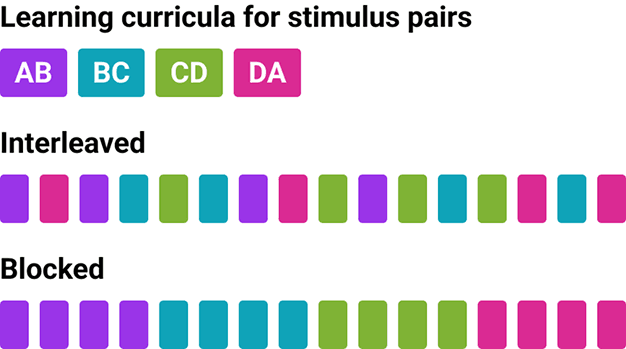
Prior work has found that interleaved learning of object pairs (AB and BC) leads to integrated representations of indirectly related items (A and C) [1].
This is the behavior expected from a conventional neural network model exposed to information in interleaved order, and we have proposed that the MSP of the hippocampus implements this strategy [2].
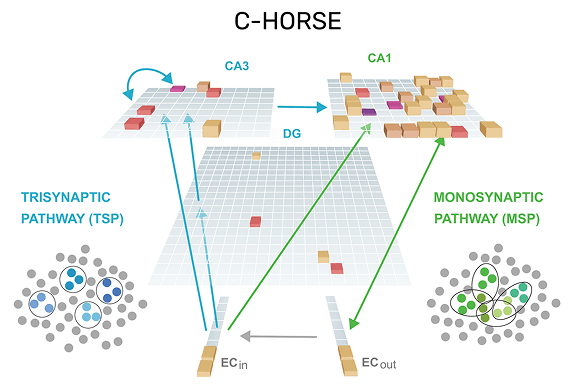
The TSP, in contrast, preserves high fidelity, separated representations of each pair, agnostic of presentation order.
Integration in MSP would also predict a relatively low fidelity representation of individual pairs.
Does interleaving overlapping stimuli lead to low-fidelity memory?
Methods
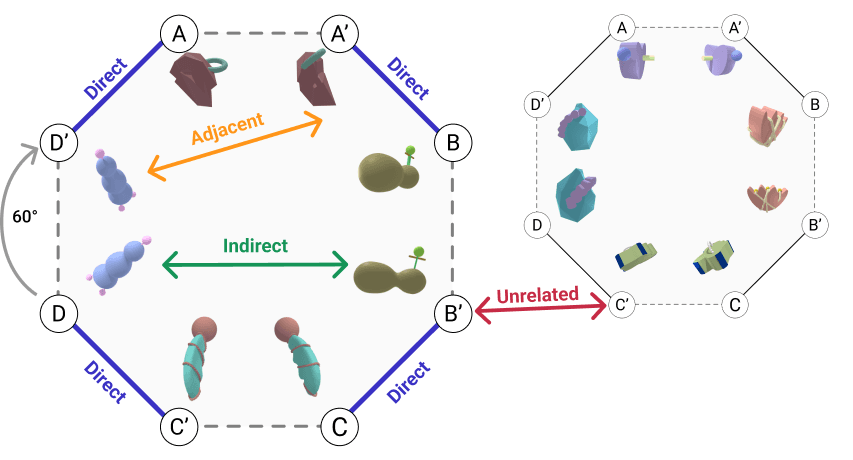
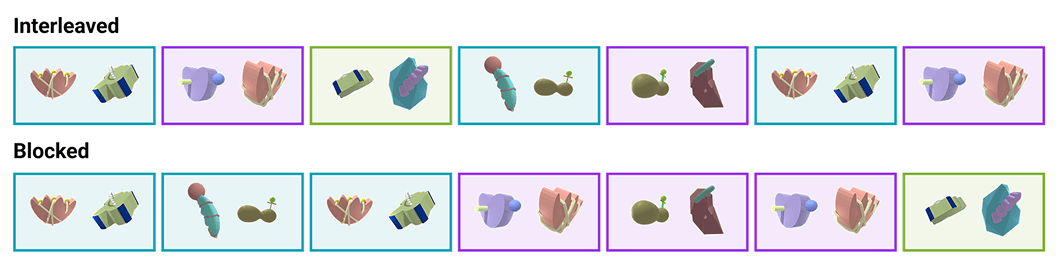
16 pairs across 4 chains. Each pair was shown 30 times.
Experiment #1: An online sample (n=34) completed one session. Experiment #2: An fMRI sample (n=30) completed two sessions separated by 7 days.
Trial Types
- Direct: Two exact objects seen together during learning.
- Adjacent: Physical objects seen together, but one is rotated.
- Indirect: Objects never seen together but on the same chain.
- Unrelated: Objects never seen together and on different chains.
Paradigm
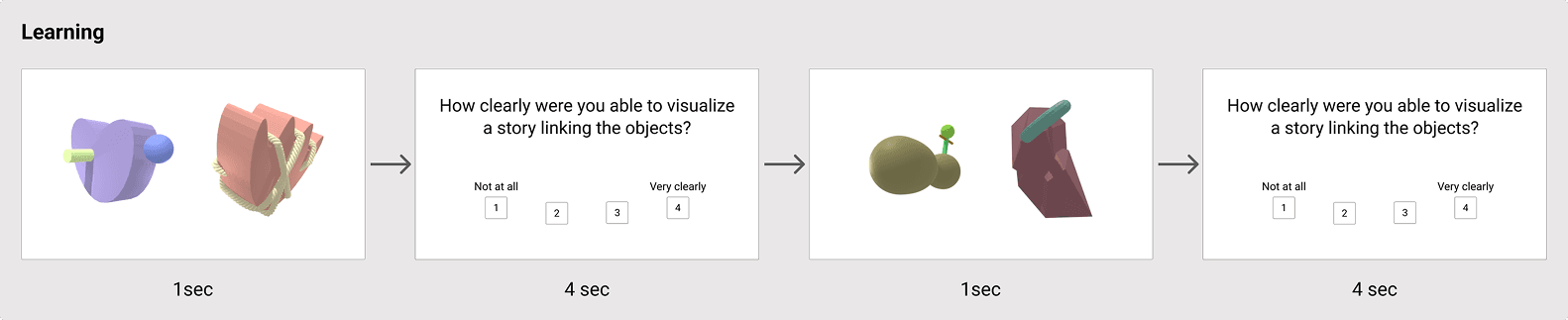
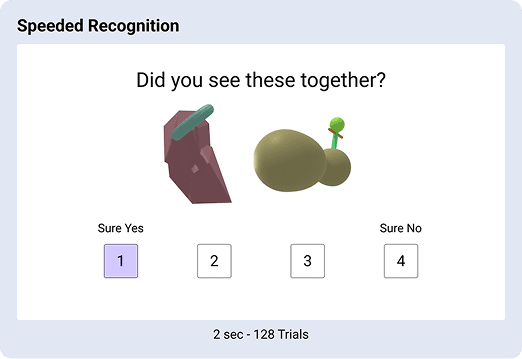
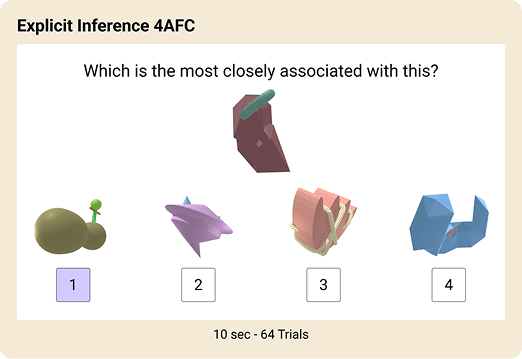
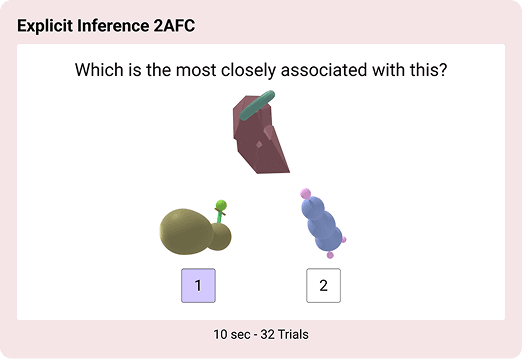
Experiment 1: Online Sample
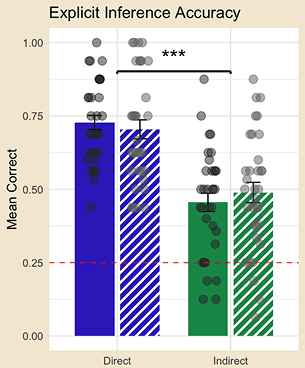
Consistent with prior literature [3,4], participants were successful in direct pair memory and indirect associative inference, with no difference between blocked and interleaved conditions.
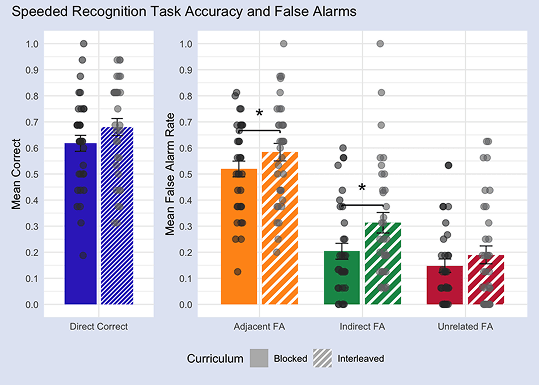
Consistent with our prior work [1], interleaved presentation led to more false alarms for indirect trials.
In addition, interleaved presentation led to more false alarms for adjacent trials.
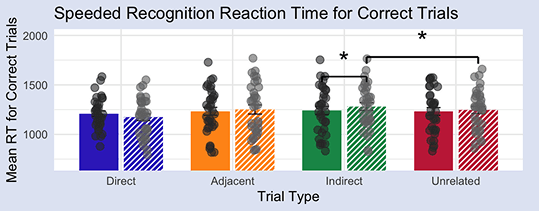
Participants were slower to correctly reject indirect associates in the interleaved case.
Experiment 2: Single Session Replication
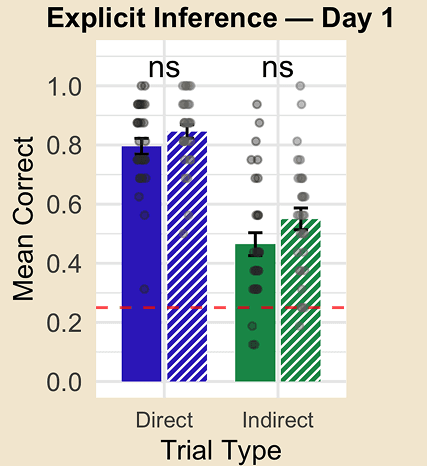
Replication of E1 pattern.
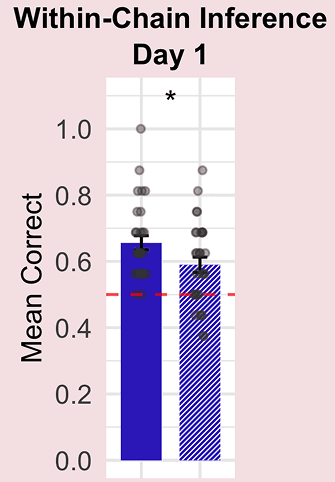
Participants showed better detail memory for pairs in the blocked condition over interleaved, consistent with the theory that interleaved presentation reduces memory fidelity.
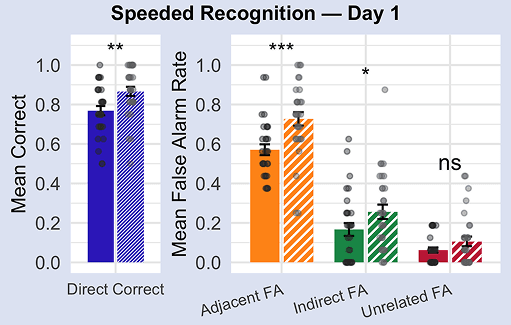
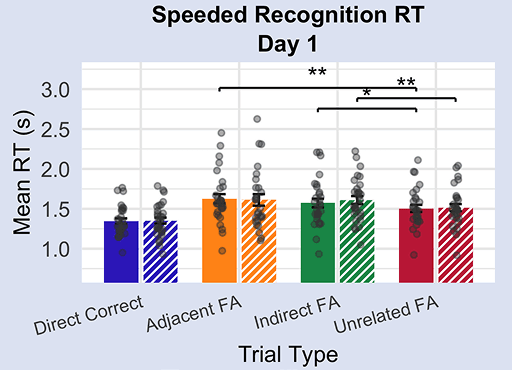
Consistent with E1, participants false alarmed more to adjacent and indirect objects when interleaved.
However, we found that participants were also less accurate for direct pairs in the blocked condition, despite better perceptual memory.
Participants were again slower to reject adjacent and indirect pairs.
Experiment 2: Delayed Testing after 7 Days
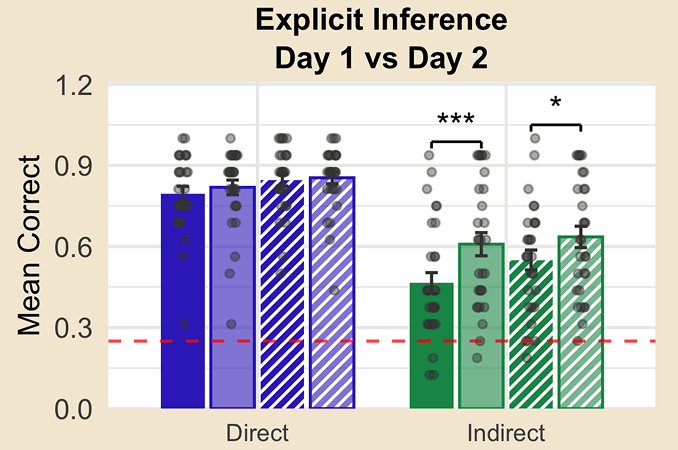
Participants showed no loss of direct pair memory, but a gain in indirect associative inference after 1 week.
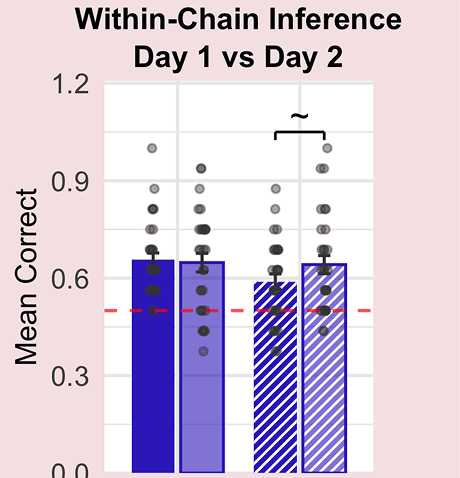
Equivalent performance on 2AFC with evidence for recovery of details 7 days later in the interleaved condition (p = 0.063).
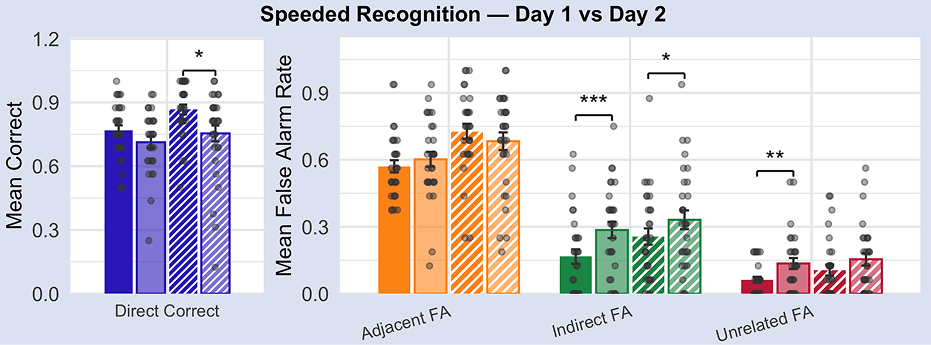
False alarm rates to indirect associates increased 7 days later.
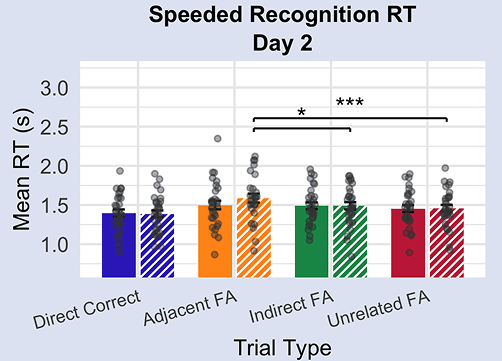
RT effects for indirect associates dissolved after 1 week.
Conclusions
- We demonstrate that an interleaved curriculum drives both integration and lower fidelity memories for object pairs, consistent with the use of interleaved learning to build distributed memory representations in the hippocampus.
- Memory of the pairs was preserved after 7 days, but integration of unseen associates improved, consistent with the possibility that offline processes support integration.
References
- Zhou, Z., Singh, D., Tandoc, M. C. & Schapiro, A. C. (2023). Building Integrated Representations Through Interleaved Learning. Journal of Experimental Psychology: General, 152(9), 2666–2684.
- Schapiro, A. C., Turk-Browne, N. B., Botvinick, M. M. & Norman, K. A. (2017). Complementary learning systems within the hippocampus: a neural network modelling approach to reconciling episodic memory with statistical learning. Philosophical Transactions of the Royal Society B: Biological Sciences, 372(1711), 20160049.
- Molitor, R. J., Sherrill, K. R., Morton, N. W., Miller, A. A. & Preston, A. R. (2020). Memory Reactivation during Learning Simultaneously Promotes Dentate Gyrus/CA 2,3 Pattern Differentiation and CA1 Memory Integration. The Journal of Neuroscience, 41(4), 726–738.
- Carpenter, A. C., Thakral, P. P., Preston, A. R. & Schacter, D. L. (2021). Reinstatement of item-specific contextual details during retrieval supports recombination-related false memories. NeuroImage, 236, 118033.
This work was funded by National Institutes of Health grant R01 MH129436.